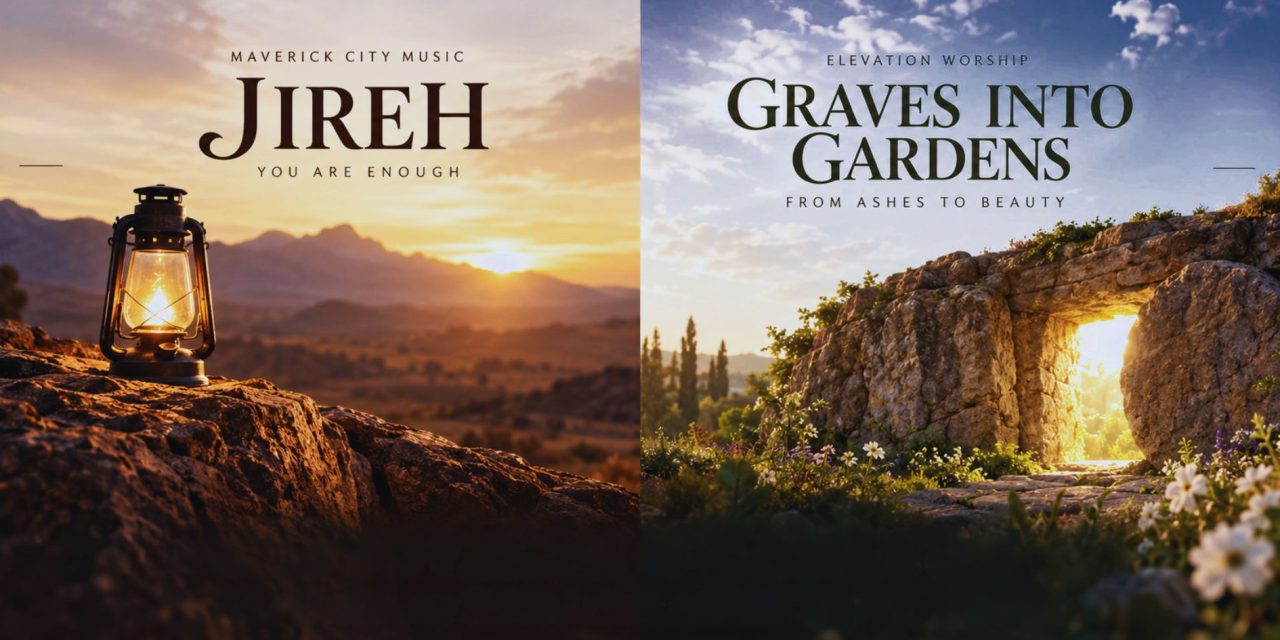
A worship song can carry a personal story without explaining every detail behind it. Sometimes, a single declaration captures the struggle, the faith, and the hope that brought the song to life.
That approach appears in the work of Maverick City Music and Elevation Worship. Their songs combine personal reflection, biblical imagery, and repeated declarations that invite listeners to participate. However, their songwriting approaches are not identical.
Examining Jireh and Graves Into Gardens reveals how these artists use different lyrical paths to express faith, provision, weakness, and transformation.
Maverick City Music: Jireh
Maverick City Music’s Jireh, featuring Chandler Moore and Naomi Raine, centres on God’s sufficiency and provision. Its repeated declaration, “Jireh, You are enough,” gives the song a clear emotional and theological focus.
The song draws its title from the biblical name associated with God’s provision. Rather than presenting provision only as financial success, its lyrics connect the theme with God’s presence, care, and sufficiency.
Chandler Moore’s vocal delivery contributes to the song’s personal quality. The performance moves between intimate declarations and fuller expressions of praise, allowing the message to feel both individual and communal.
The song also demonstrates how repetition can strengthen a worship composition. Its central phrases return throughout the arrangement, giving congregations opportunities to join in without navigating overly complicated lyrics.
Jireh became a prominent release for Maverick City Music and its collaborators. However, its significance cannot be measured through streaming numbers alone. The song’s lyrical focus, vocal performance, and use in worship settings all contribute to how listeners experience it.
The track shows how testimony-centered worship can communicate personal faith without requiring a detailed account of every event behind the song.
Elevation Worship: Graves Into Gardens
Elevation Worship’s Graves Into Gardens, featuring Brandon Lake, approaches testimony through personal confession and biblical imagery. Its lyrics move from acknowledging weakness and disappointment toward declarations about God’s transforming power.
The song was written by Brandon Lake, Chris Brown, Steven Furtick, and Tiffany Hammer. The official Elevation Worship song page confirms these songwriting credits.
One of its strongest features is the contrast between personal and biblical language. The verses refer to weakness, failure, and God’s friendship. The bridge then expands into images of mourning becoming dancing, ashes becoming beauty, and graves becoming gardens.
These images draw from biblical themes while remaining accessible to listeners facing different circumstances. Someone experiencing loss may connect with the language of restoration, while another worshipper may focus on God’s faithfulness during personal weakness.
The song’s development also reflects a less rigid songwriting process. In an interview with Worship Leader, Chris Brown explained that the writing session began without a tightly planned creative direction. He described the team exploring what they wanted to write rather than forcing the song into an established formula.
That detail offers useful context for understanding the song’s creative background. Its testimony-centered quality does not depend on a single documented personal event. Instead, the writers combine personal vulnerability, biblical references, and congregational declarations.
The result is a song that presents transformation through both intimate confession and expansive worship language.
Comparing the Artists’ Approaches
Although Jireh and Graves Into Gardens share themes of faith and dependence on God, they approach those themes differently.
| Artist and song | Central emphasis | Songwriting approach |
| Maverick City Music — Jireh | God’s sufficiency and provision | Repeated declarations, personal vocal expression, and a focused central message |
| Elevation Worship — Graves Into Gardens | Restoration and God’s transforming power | Personal confession, biblical imagery, and progressively expanding declarations |
These songs should not be treated as identical examples of testimony songwriting. Jireh focuses strongly on God’s sufficiency, while Graves Into Gardens develops its message through contrasts between weakness, loss, and transformation.
Both approaches show how worship artists can create songs that connect individual faith with shared congregational expression.
What These Songs Reveal About Worship Songwriting
The work of Maverick City Music and Elevation Worship highlights several songwriting choices.
Personal themes can carry broad meaning. A song does not need to describe every detail of an artist’s experience to communicate something listeners recognise.
Biblical imagery can deepen emotional expression. References to provision, restoration, and transformation give worship lyrics a foundation beyond personal sentiment.
Repetition can support participation. Memorable declarations help listeners engage with the song, particularly during live worship.
Vocal delivery shapes the testimony. The way an artist sings a lyric influences whether it feels intimate, declarative, reflective, or celebratory.
Different songwriting paths can serve similar purposes. Artists may begin with personal reflection, biblical language, musical experimentation, or a central declaration. Their creative processes do not need to follow one formula.
Conclusion
Maverick City Music’s Jireh and Elevation Worship’s Graves Into Gardens show how contemporary worship artists connect faith with personal and biblical themes.
Their approaches differ, but both songs use focused messages, memorable lyrics, and expressive performances to invite participation. Their examples demonstrate that testimony-centered worship is not limited to one songwriting structure or emotional style.
The most useful lesson comes from studying what each artist actually does. Their lyrics, collaborations, vocal choices, and creative processes offer a clearer picture than broad claims about the worship music industry.
Ever sung a worship song that gave words to something you had struggled to explain? DLK Praise and Worship explores how artists turn faith, biblical truth, and personal experience into songs that connect with everyday worshippers.