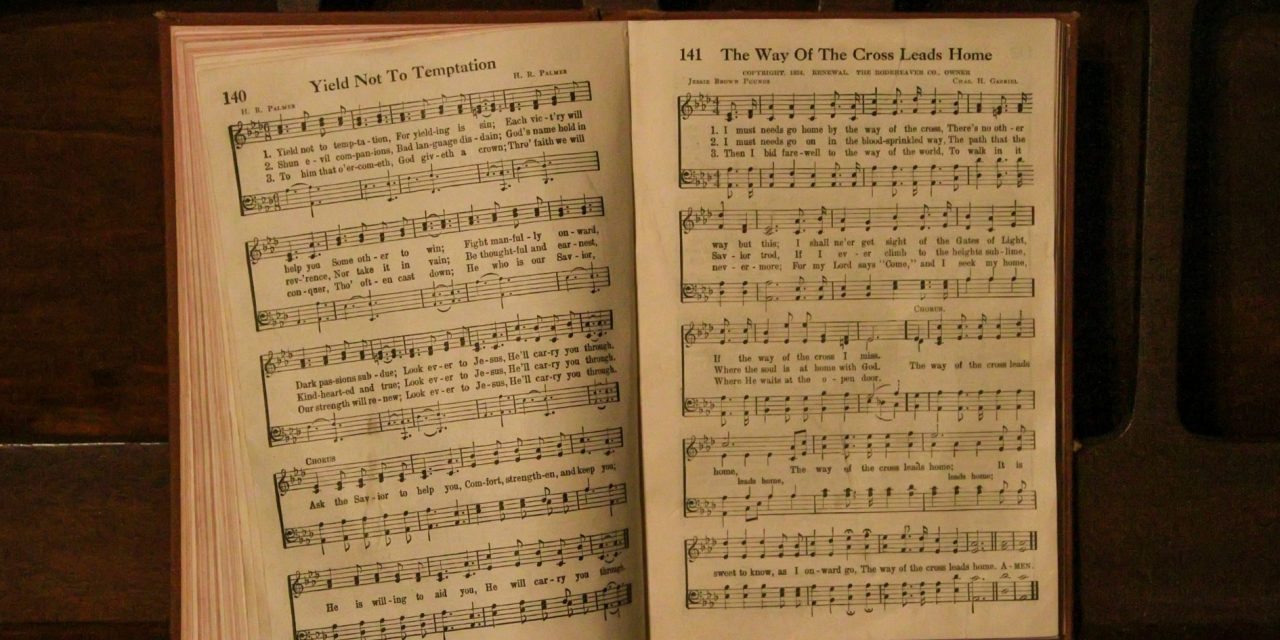
Have you ever sung a hymn confidently while wondering what one of its lines actually means?
Take “Here I raise mine Ebenezer.” We may know the melody and sing the words without hesitation, yet the meaning of “Ebenezer” is not immediately clear to a modern congregation. If we do not understand the word, part of the line’s message can pass us by.
Why does this happen with hymns we may have sung for years? Classic hymns often use vocabulary, sentence structures, and biblical imagery that were familiar to earlier generations but feel distant today.
And what happens when we know the melody but miss the meaning?
That question matters because classic hymns often carry substantial theology in surprisingly compact phrases. Before exploring how churches can help congregations engage with unfamiliar language, we first need to understand why these words feel foreign and what can be lost when their meaning is overlooked.
Why Classic Hymns Feel Like a Foreign Language
For many modern worshipers, singing a classic hymn can feel like opening a linguistic time capsule.
The melody may be familiar, but the lyrics can leave people singing confidently while mentally translating every few lines.
That does not mean anyone lacks spiritual understanding. It reflects the distance between the English of another era and the English we use today.
Language constantly changes. Words gain new meanings, lose old ones, and eventually disappear from everyday speech.
Much of the vocabulary found in 18th- and 19th-century hymnody came from a world shaped by the King James Bible, formal poetry, and a culture that relied more heavily on reading aloud.
What sounded completely natural to writers such as Isaac Watts or Charles Wesley can sound formal or confusing to a modern listener.
The issue extends beyond individual words. Hymns also use sentence structures, imagery, and theological expressions that modern worshipers may rarely encounter elsewhere.
That makes understanding the language an important part of understanding the song.
The goal is not to flatten the language or rewrite every unfamiliar phrase. Classic hymns have their own beauty, history, and theological richness.
The goal is to open the door so people can understand what they are already being invited to sing.
Archaic Words, Inverted Syntax, and Biblical Imagery
The most obvious barrier is vocabulary.
Words such as “thou,” “hath,” and “dost” have largely disappeared from everyday English. Yet they remain familiar residents of older hymns and Scripture.
These forms were not originally special religious language. “Thou,” for example, was simply a singular form of “you.” Over time, everyday English changed while these forms remained in certain religious and literary contexts.
Several categories can create confusion for modern singers:
- Archaic pronouns and verb forms: thee, thou, thine, ye, dost, hath, doth, shalt, wilt, art, and wert. These forms communicate person and tense in ways modern English usually handles differently.
- Inverted syntax: phrases such as “Praise we the Lord” use an older word order that can sound unusual to contemporary ears.
- Dense biblical imagery: references to farming, shepherding, warfare, sacrifice, and temple worship may once have been immediately recognizable but can now require more context.
Even familiar-looking words can cause problems when their older meaning differs from today’s usage.
A little etymology, or attention to a word’s origin and development, can sometimes reveal what is happening.
“Hath” is an older form of “has,” while “dost” relates to the older form of “do.” “Wert” is an older past form of “are,” as in “Thou wert.”
Once those patterns become familiar, the language can stop looking like a collection of strange syllables.
Inverted syntax has its own history. Earlier forms of English allowed greater flexibility in word order, while hymn writers also worked within the demands of meter and rhyme.
Biblical translation further influenced the sound and structure of sacred language.
When a hymn places words in an unfamiliar order, the line may therefore reflect poetry, Scripture, or both.
Understanding that background can help worshipers hear the meaning rather than getting stuck on the wording.
Why the Effort Is Worth It for Congregations
Helping people understand older hymn language can deepen theological understanding, strengthen historical connection, and encourage fuller participation.
When people understand what they are singing, the words become more than something they recite from memory.
They can begin to recognize the truth those words are expressing and respond to it more consciously.
Classic hymns often carry a particularly rich theological vocabulary. Consider Charles Wesley’s “And Can It Be,” which uses language about immense love and being bound in sin.
Those phrases are not merely poetic decoration. They communicate substantial ideas about grace, sin, salvation, and God’s love.
When a congregation understands that language, the hymn can become an opportunity to engage with those truths rather than simply repeat them.
There is also a historical dimension.
Singing texts that Christians have used across generations connects a local congregation with the wider history of Christian worship.
The church is not beginning its worship vocabulary from scratch every Sunday. It is inheriting songs, language, and theological ideas that have travelled through generations.
That connection can be especially meaningful when congregations include people from different ages and backgrounds.
Shared understanding also builds unity. When younger worshipers, longtime members, and newcomers can grasp the same lyrics, unfamiliar vocabulary becomes less of a barrier.
The hymn can then function as a shared language rather than a dividing line.
That is why the effort matters. The aim is not simply to make old words easier.
It is to help the congregation discover the meaning, theology, and history those words have carried for generations.
Conclusion
Classic hymns do not become irrelevant simply because some of their language has become unfamiliar. Their words may require more attention today, but that unfamiliarity can also become an invitation to learn.
When congregations understand the language they sing, familiar hymns can reveal theological depth that might otherwise remain hidden behind an old-fashioned phrase.
So, what do you do when the hymn is worth keeping, but half the congregation may not understand what they are singing? DLK Praise and Worship explores practical ways to close that gap while keeping the worship experience intact.