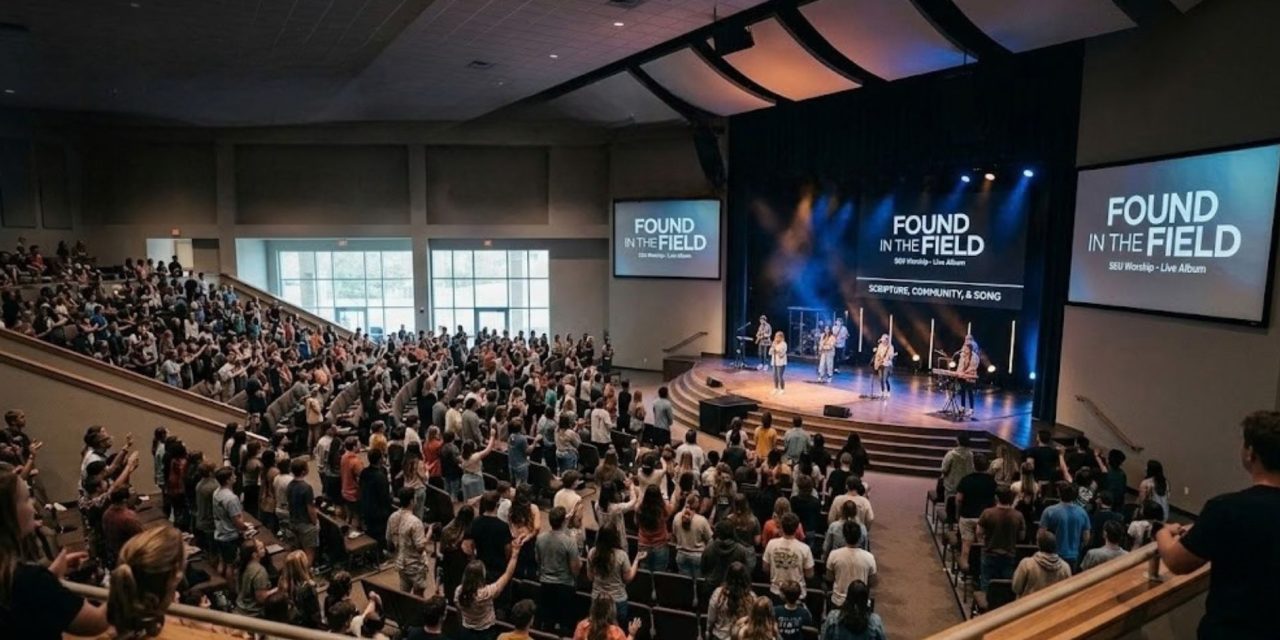
SEU Worship’s Found in the Field is a live worship album shaped by Southeastern University’s student worship community.
That detail matters because the project was not created to sound good through headphones. Its songs are intended to work in the gathered church, where a worship team has to lead people who did not rehearse the bridge three times beforehand.
The album brings together three important ideas: Scripture, community, and the local church. Its title draws from biblical imagery of the field, while its songs reflect the experience of students and leaders learning to write, lead, and serve through worship ministry.
For worship leaders and songwriters, Found in the Field offers more than another collection of songs. It provides an example of how a worship collective can develop music while keeping congregational participation at the centre.
What SEU Worship’s Found in the Field Is and Why It Matters
Found in the Field is a live worship album from SEU Worship, the worship collective connected with Southeastern University.
The collective brings students and leaders together to write, record, and lead worship while developing their skills through ministry.
That gives the album a distinctive dual identity. It is a creative project shaped by melody, musicianship, songwriting, and lyrical depth. It is also a ministry resource designed with congregational worship in mind.
That distinction matters.
Some worship releases are built primarily for listening. Their layered productions and elaborate vocal arrangements can sound impressive while becoming difficult for a local church team to reproduce.
Found in the Field takes a more congregational approach. Its songs are designed to be sung by people gathered together, rather than simply performed in front of them.
For worship leaders, that creates an important consideration. A useful worship song needs more than strong production. It needs theological substance, accessible melodies, and lyrics that a congregation can actually carry.
The album therefore sits at the intersection of Scripture, community, and the local church. Those three ideas shape its identity and help explain why the project deserves closer attention.
Where the Album Fits in SEU Worship’s Story
Found in the Field forms part of SEU Worship’s continuing work of releasing worship music while training students for ministry. The album is therefore not an isolated creative project. It represents another chapter in a wider process of equipping worship leaders and songwriters.
That process has two connected sides. The collective creates and releases music, but it also functions as a training environment.
Students develop skills in arrangement, rehearsal, stage communication, and pastoral sensitivity while serving in worship settings. That practical experience can shape the songs themselves.
Students can test their writing in chapel services, student gatherings, and local churches. They learn what works when real people are singing along, rather than relying only on how a song feels during rehearsal.
A bridge might sound enormous with a full band in the room, for example. Put it in front of a congregation hearing it for the first time, and suddenly that “huge moment” may need a little help.
That feedback loop can strengthen songwriting.
Found in the Field reflects a collective learning to balance artistic ambition with congregational usability. The arrangements leave room for participation, while the lyrics carry substance without becoming unnecessarily complicated.
The live setting also contributes to the album’s character. Music recorded around a gathered community carries a different energy from tracks assembled entirely inside a studio.
For worship leaders observing the wider worship landscape, this model offers an interesting example. A worship collective can create music while discipling the people creating it.
The album becomes both a finished project and evidence of that ongoing process.
The Field as a Biblical Image: Scripture Behind the Title
The title Found in the Field draws on biblical imagery surrounding fields and harvest.
Across Scripture, the field can represent a world where people are ready to hear and respond to God’s message. In the Gospels, Jesus repeatedly uses harvest imagery when speaking about mission and the people God is sending into the world.
In Matthew 9:37–38, Jesus tells His disciples that the harvest is plentiful but the workers are few. He then tells them to ask the Lord of the harvest to send workers into His harvest.
The setting matters.
Jesus speaks these words after seeing crowds who were harassed and helpless, describing them as sheep without a shepherd. The image connects the harvest with compassion and a willingness to serve people who need care.
John 4:35 develops the imagery further. Jesus tells His disciples to lift their eyes and look at the fields because they are already white for harvest.
The timing is significant because this follows His conversation with the Samaritan woman. The field is therefore not merely an abstract picture of future mission. It includes actual people and encounters happening in the present.
Luke 10:2 uses the same harvest language when Jesus sends out the seventy-two. Again, the emphasis falls on God’s harvest, and the workers sent into it.
Together, these passages create a picture of availability, service, and participation in what God is already doing.
Being found in the field can therefore suggest being present where God has called His people to serve. It carries a sense of readiness rather than simply observation.
That biblical foundation gives the album’s title greater weight. Congregations can sing about being available to God and participating in His work without reducing the idea of mission to a catchy phrase.
How DLK Praise and Worship Covers Worship Music Like This
DLK Praise and Worship approaches worship music with an interest that goes beyond whether a new release sounds good.
When a project such as SEU Worship’s Found in the Field arrives, the more useful question is how its music, theology, songwriting, and ministry purpose connect with the church.
DLK Praise and Worship is a faith-centered digital music and media brand covering Christian praise and worship, congregational music, worship leadership, songwriting, musicianship, and church music culture.
It is part of the DLK Music family and serves an international online audience interested in worship and Christian music.
Coverage can take different forms depending on the project.
An album feature might examine the biblical themes running through its songs. Another article might look at arrangement choices, key selections, or whether a chorus sits comfortably within a congregation’s vocal range.
A songwriting feature might instead examine how a particular lyric communicates theology without becoming difficult for a congregation to sing.
The common thread is substance.
Musical insight and theological reflection belong in the same conversation because the songs churches sing can shape what those churches remember, believe, and pray.
That makes thoughtful worship coverage useful for more than musicians. It gives worship leaders, songwriters, and church teams another way to think carefully about the music they are placing before their congregations.
Editorial Content for Worship Leaders, Musicians, and Songwriters
DLK Praise and Worship publishes content designed to give worship leaders, musicians, and songwriters practical tools alongside spiritual encouragement.
The editorial approach prioritizes quality over quantity, clear topics, and connected expertise.
In practical terms, that means addressing questions worship teams actually face.
A worship leader preparing a Sunday set might need guidance on creating smoother transitions between songs. A volunteer vocalist could benefit from advice on protecting their voice through a demanding weekend of services.
A songwriter might be more interested in writing lyrics that a whole congregation can remember and sing, rather than lyrics that only work for a solo performer.
Other articles take a wider view.
Album features can introduce new releases while considering how their songs might function within a local church. Artist and songwriter coverage can explore the people behind the music and the ministry environments shaping their work.
Worship-song discussions can also unpack the theology and biblical themes carried by a single lyric or chorus.
Church-music education, worship-event coverage, ministry-focused articles, and spiritual encouragement add further depth to the editorial mix.
The audience is equally broad.
Some readers serve large churches with full bands and production teams. Others lead worship with one guitar in a small sanctuary.
Both settings matter.
DLK Praise and Worship does not assume that every reader has formal musical training, professional equipment, or a large team. The goal is to provide useful ideas that can travel across different church environments.
When it genuinely benefits readers, the brand may also connect them with DLK Praise & Worship music, videos, playlists, merchandise, and related initiatives.
Editorial content, however, stands on its own. It is not simply a catalogue dressed up as an article.
The larger purpose is straightforward: help worship leaders, musicians, and songwriters serve their congregations with music that is thoughtful, biblical, and genuinely singable.
Conclusion
Found in the Field brings together more than live worship recordings. Scripture, a student worship community, and a clear concern for the local church shape its identity.
Its field imagery points toward biblical ideas of harvest, service, and availability. And its origins at Southeastern University show how worship music can develop alongside the people learning to lead it.
That combination makes the album particularly relevant to worship teams thinking about what they sing and why they sing it.
What makes a worship song stay with you after Sunday ends: the melody, the words, or the Scripture behind them? DLK Praise and Worship explores the songs, writers, and worship moments that give those questions something worth singing about.