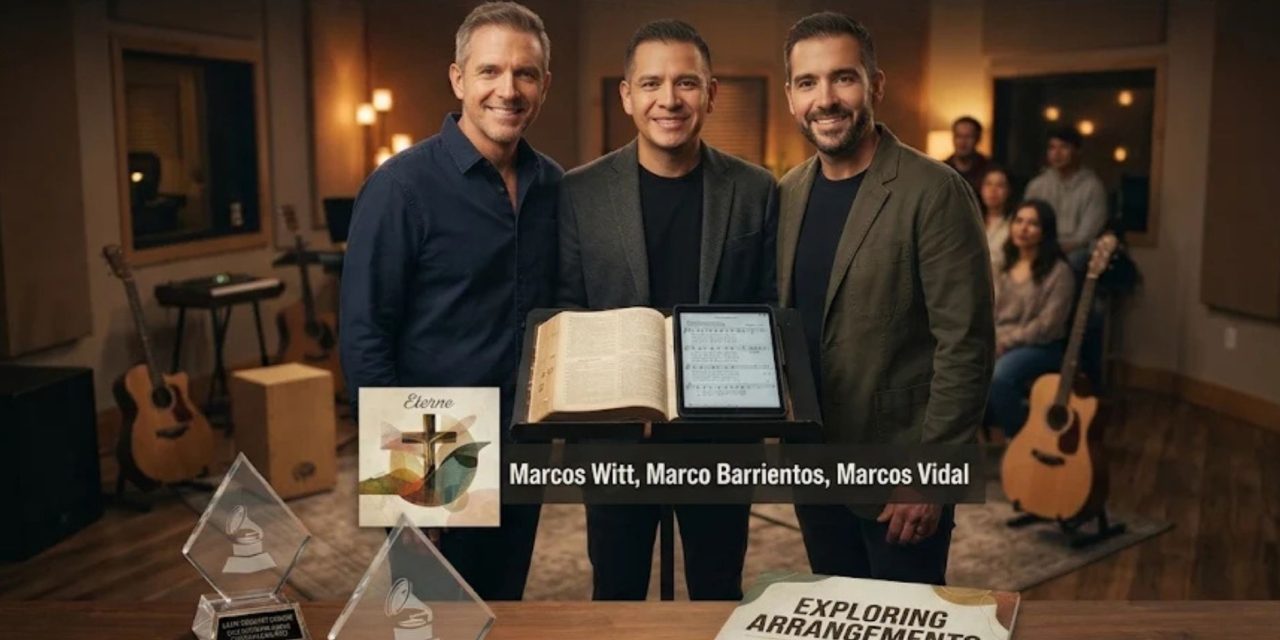
When three established worship leaders come together on one album, familiar hymns offer a natural place to begin listening. Eterno, by Marcos Witt, Marco Barrientos, and Marcos Vidal, brings their contributions together through Spanish-language worship music. The album also earned significant recognition, winning Best Christian Album (Spanish Language) at the 27th Latin GRAMMY Awards on November 12.
The award gives listeners another reason to revisit the project. But beyond the recognition, Eterno offers worship teams something practical to explore. Its familiar hymns provide an opportunity to consider melody, vocal leadership, congregational participation, and arrangement choices. Two tracks, “Sublime Gracia” and “A Dios Sea la Gloria,” offer particularly useful starting points.
Three Worship Leaders, Different Contributions
Heaven Music’s album listing opens with “Sublime Gracia” and “A Dios Sea la Gloria.” Both tracks credit Witt, Barrientos, and Vidal.
The album credits also reveal how the project makes room for individual contributions. Spotify’s album listing credits Witt alone on “Oh Tu Fidelidad,” Vidal on “En el Monte Calvario,” and Barrientos on “Sin Reservas.”
This gives listeners two ways to approach Eterno. The shared tracks provide an opportunity to hear the three artists working together. The individually credited selections offer another perspective on their respective contributions.
For worship teams, starting with the shared hymns makes sense. These tracks provide familiar material for examining how different voices can serve one song. They also create a practical listening exercise before the team explores the rest of the album.
“Sublime Gracia”: Find the First Place People Can Join
Begin with “Sublime Gracia” and follow the melody without immediately focusing on every vocal detail. The first listen should establish how the hymn moves and where its phrases naturally settle.
On a second listen, identify where someone familiar with the hymn could comfortably begin singing. Pay attention to the transition between the opening and the first point where the congregation might join.
This is an important consideration when adapting an arrangement for corporate worship. A beautiful musical introduction can still leave the congregation unsure about when to enter.
Try having one singer lead that first entrance during rehearsal. Then ask the remaining singers to join from the room. This helps the team determine whether the cue is clear before adding harmonies or a fuller instrumental arrangement.
The goal isn’t necessarily to reproduce every detail of the recording. It’s to identify what helps people participate confidently.
“A Dios Sea la Gloria”: Make the Vocal Handoff Clear
Next, explore “A Dios Sea la Gloria” with particular attention to vocal leadership. Since all three artists receive credit, the track offers another entry point for considering how multiple voices can contribute to one hymn.
Try assigning the opening phrase to one singer. Let the rest of the team enter together at a point everyone can anticipate. Then repeat the exercise with a different singer carrying the melody.
Notice whether the change makes the entrance easier or harder to follow. If the congregation would struggle to recognize the transition, keep the lead consistent at that point. Additional voices can enter later, where the arrangement allows a clearer handoff.
This exercise helps worship teams distinguish between vocal variety and unnecessary complexity. Multiple singers can enrich an arrangement, but their entrances should still serve the song.
A useful arrangement gives each voice room without making the congregation work harder to follow the melody.
Bring One Useful Decision Into Rehearsal
Listening to Eterno can inspire several arrangement ideas, but a worship team doesn’t need to adopt everything at once. Start with one hymn and identify the elements that would genuinely help your congregation participate.
Choose a key that considers the congregation’s comfortable vocal range. Agree on the opening entrance, identify any vocal handoffs, and settle on the final ending.
Then ask someone standing away from the microphones to sing along. Find out where they hesitated or struggled to follow the arrangement. That feedback can reveal problems that performers might miss while rehearsing onstage.
You can also explore both tracks through Witt’s official album visualizer on YouTube.
Ultimately, Eterno offers more than an opportunity to hear three established worship leaders revisit familiar hymns in Spanish. It gives worship teams material for thinking carefully about how familiar melodies, vocal arrangements, and clear musical cues work together.
The most valuable takeaway might be a small adjustment rather than an elaborate new arrangement. Sometimes, one clearer entrance or a better vocal handoff makes it easier for an entire congregation to sing.
What makes a familiar hymn easier for a congregation to embrace, even when its arrangement changes? Discover more worship albums, ministry insights, and music features on DLK Praise and Worship.