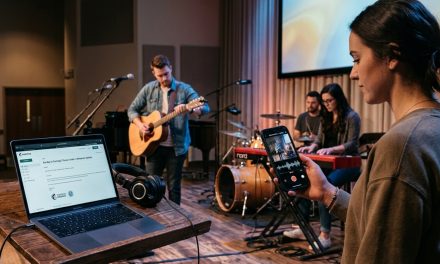
A worship song can have a full band, layered harmonies, cinematic strings, and enough reverb to baptise the sound engineer. Yet sometimes, a guitarist and one vocalist hold the room more effectively.
It is not necessarily because acoustic music is more spiritual or electronically produced music lacks feeling. The difference may come from how listeners respond to musical simplicity, vocal expression, anticipation, and shared participation.
Music influences emotion and attention in complex ways, and research offers useful insights into these responses. However, the brain is not a worship critic handing out extra points whenever someone removes the drum kit.
So why do stripped-down worship arrangements often feel so personal? From live vocals and musical tension to congregational singing, this article examines the psychology behind acoustic worship and what church leaders can learn from it.
Psychological and Neurological Appeal
A heavily produced worship track can fill a room with sound. An acoustic guitar and an honest vocal can make that same room feel surprisingly close.
This contrast helps explain why acoustic-rooted worship continues to appeal to listeners. The experience is not simply about removing instruments. It involves how people process musical emotion, interpret vocal expression, and participate with others.
Research shows that music engages several brain networks associated with emotion, attention, reward, movement, and social processing. Studies do not support a simple rule that acoustic music activates the brain more deeply than electronic production.
Instead, musical responses depend on the listener, the arrangement, the setting, and the emotional meaning attached to the music.
For worship leaders, this distinction matters. Acoustic music may create a more intimate atmosphere, but its effectiveness depends on thoughtful choices rather than instrumentation alone.
1. Emotional Connection and Musical Authenticity
A live vocal does not need to sound flawless to communicate emotion. Small changes in breath, phrasing, and vocal texture can make a performance feel personal.
Listeners may respond to these expressive details because music communicates more than pitch and rhythm. It can also convey tension, vulnerability, anticipation, and emotional intensity.
Research on music and emotion identifies activity across several brain regions. These include areas involved in auditory processing, emotional responses, reward, and cognitive interpretation.
However, there is no strong basis for claiming that live vocals consistently increase oxytocin or that removing auto-tune automatically produces greater emotional connection.
The setting still matters. A singer performing with acoustic guitar may appear more accessible, while a carefully produced arrangement may communicate emotion just as effectively.
2. The Role of Live Music in Shared Worship
Live music offers something recorded tracks cannot fully reproduce: the possibility of responding to the people in the room.
A worship leader may slow down, repeat a chorus, or leave space after a lyric. Musicians can respond to the congregation rather than following a fixed recording from beginning to end.
Research published in 2024 found that live music produced stronger and more consistent activity in brain networks associated with emotional processing than comparable recorded music. The study focused on live piano performances, not worship services specifically.
This finding does not prove that every live worship performance creates a stronger spiritual response. It does suggest that real-time musical interaction deserves attention.
Acoustic arrangements can support this flexibility. With fewer layers competing for space, musicians may find it easier to adjust the performance to the congregation’s pace.
3. Slower Tempos, Attention, and Emotional Space
Slower worship songs can create room for reflection, but a specific tempo does not guarantee a particular brainwave pattern or emotional response.
The original claim that acoustic worship at 68–72 BPM reliably produces dominant alpha brainwaves is too broad. Brain activity varies according to the listener, task, environment, and emotional state.
A slower arrangement may still influence the worship experience through musical anticipation and release. A held chord, repeated phrase, or gradual instrumental build can create a sense of expectation.
David Huron’s Sweet Anticipation examines how musical expectations shape emotional responses. Its ideas can help worship leaders think about how repetition, surprise, and resolution influence listening.
The practical lesson is not to chase one ideal tempo. It is to choose pacing that supports the song’s message and gives the congregation space to respond.
4. Why Simplicity Can Encourage Participation
An acoustic arrangement can reduce the number of musical elements competing for attention. This may make the melody, lyrics, and vocal expression easier to follow.
However, simplicity does not always mean accessibility. A quiet arrangement with an uncomfortable key can still leave a congregation struggling.
Leaders should consider vocal range, lyrical clarity, instrumental volume, and the congregation’s familiarity with the song.
A stripped-down version of a familiar worship song may encourage participation because people already understand its melody. A new song may require more preparation, regardless of how many instruments accompany it.
The goal is to make musical choices that support participation without confusing simplicity with automatic effectiveness.
Conclusion
Acoustic worship offers more than a change in instrumentation. It can create opportunities for musical intimacy, live interaction, emotional expression, and shared participation.
Research supports the idea that music influences emotional and social processing. However, it does not establish that acoustic music always produces deeper neurological or spiritual effects.
Church leaders should therefore approach acoustic worship with both curiosity and discernment. Simple arrangements can be meaningful, but thoughtful preparation remains essential.
When musicians leave room for the congregation, worship can feel less like a polished presentation and more like a shared response.
Ever heard a worship song stripped down to one voice and a few chords, then felt the lyrics hit harder than the full production ever did? DLK Praise and Worship explores the moments when music, Scripture, and prayer meet, from quiet personal reflection to the sound of an entire congregation finding its voice.