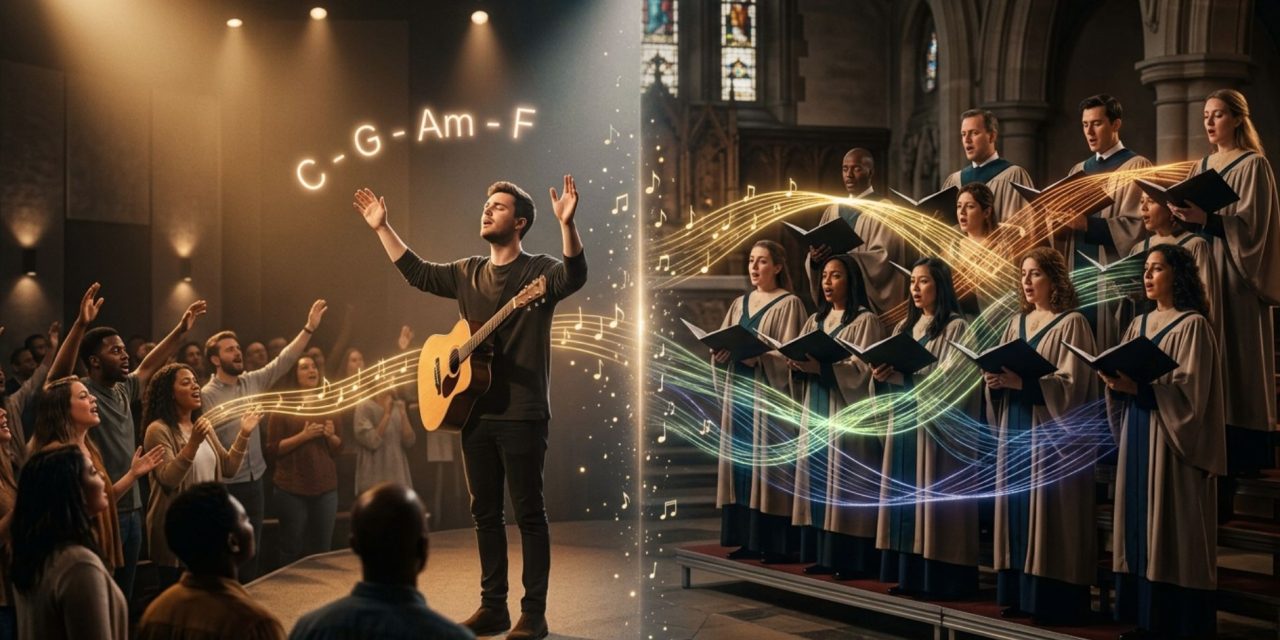
Modern worship music has mastered the art of making thousands of people sing the same line at once. Four chords, one memorable hook, and suddenly the entire room sounds united. It is beautifully accessible. It is also mildly terrifying for choir directors staring at an SATB arrangement sheet wondering where exactly the altos are supposed to go for the next six minutes.
That tension sits at the center of today’s worship culture. Simplicity helps congregations engage quickly, but choirs naturally crave harmonic movement, layered dynamics, and richer vocal textures. Balancing those two worlds has become one of the biggest modern church music challenges.
When Simplicity Meets Choral Depth
Elevation Worship’s “Graves Into Gardens” runs on a straightforward C-G-Am-F progression. The simplicity makes it instantly congregational, but it leaves limited harmonic room for traditional choir movement. Large choir sections can easily overcrowd the arrangement if every vocal line fights for attention.
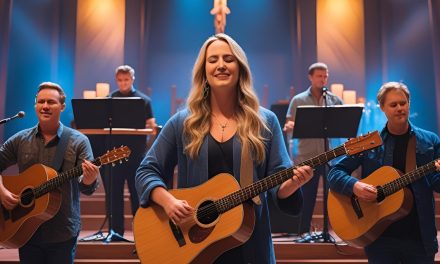
Meanwhile, Hillsong Young & Free often leans into repetitive 3-chord structures designed for energetic acoustic worship settings. These songs thrive because people learn them quickly. However, integrating a full choir requires restraint. Over-arranging the harmonies can accidentally shift the focus away from worship participation and toward performance.
Maverick City Music approaches the problem differently. Many of their melodies rely heavily on spontaneous worship energy and gospel-inspired vocal layering. Some songs almost feel unfinished without harmonic support underneath them. That creates opportunities for choirs to introduce simple counter-lines, octave doubling, or sustained harmonies that deepen the atmosphere without dominating the lead melody.
At the minimalist end, Passion Conferences worship tracks frequently depend on loops and repetition. Traditional SATB structures can sound stiff against that modern worship flow. Choir comeback strategies now focus less on complex arrangements and more on selective texture-building. Sustained pads, echo phrases, and staggered harmonies tend to work better than fully scored hymn-style writing.
Chord Complexity Comparison
| Song Style | Average Chords per Song |
| Modern Worship | 3.2 |
| Traditional Hymns | 6.8 |
According to PraiseCharts’ 2023 analysis, this harmonic gap explains why many church choirs initially struggle with contemporary worship transitions. Traditional hymns naturally support richer harmonic movement because the chord structures constantly evolve. Modern worship intentionally removes much of that complexity to maximize accessibility.
That does not mean choirs are becoming irrelevant. It simply means their role is changing.
Instead of carrying the entire harmonic identity of a song, modern choirs often function as atmospheric reinforcement. Directors increasingly focus on:
- beginner harmonies
- octave layering
- dynamic swells
- call-and-response sections
- sustained vowel pads
These techniques preserve congregational accessibility while still allowing choir participation to feel meaningful.
Many experts recommend rehearsing limited progressions repeatedly before introducing more advanced harmony structures. Practicing on familiar worship songs from artists like Hillsong Worship can help volunteer choirs build confidence without overwhelming less experienced singers.
Spectrogram Insights: Solo vs Choir
Spectrogram comparisons between solo worship recordings and choir-enhanced versions reveal something fascinating. Solo vocals often leave noticeable gaps across low and upper-mid frequency ranges. Once choir layers enter, the frequency spectrum becomes fuller and more balanced.
Soprano, alto, tenor, and bass voices naturally occupy different sonic spaces. Together, they create warmth and density that cannot easily be replicated by instruments alone.
This explains why many worship production teams are rediscovering choir integration in contemporary services. Choirs can add emotional depth without requiring additional guitars, synths, or elaborate orchestration. In modern worship, vocal stacks often function like invisible instrumentation.
For practical application, some choir directors now record rehearsal takes and compare the frequency balance between solo and layered versions. This helps refine:
- harmonic balance
- vowel blending
- choir dynamics
- vocal spacing in live mixes
Small adjustments can dramatically improve how a choir supports modern worship arrangements.
Conclusion
The future of worship choirs may not look like massive cathedral harmonies every Sunday. Instead, it may involve choirs learning how to serve minimalist worship spaces with precision, restraint, and texture-driven creativity.
Can modern worship finally find the sweet spot between congregational simplicity and rich choral depth? Follow evolving worship arrangement trends and choir integration strategies only at DLK Praise and Worship!