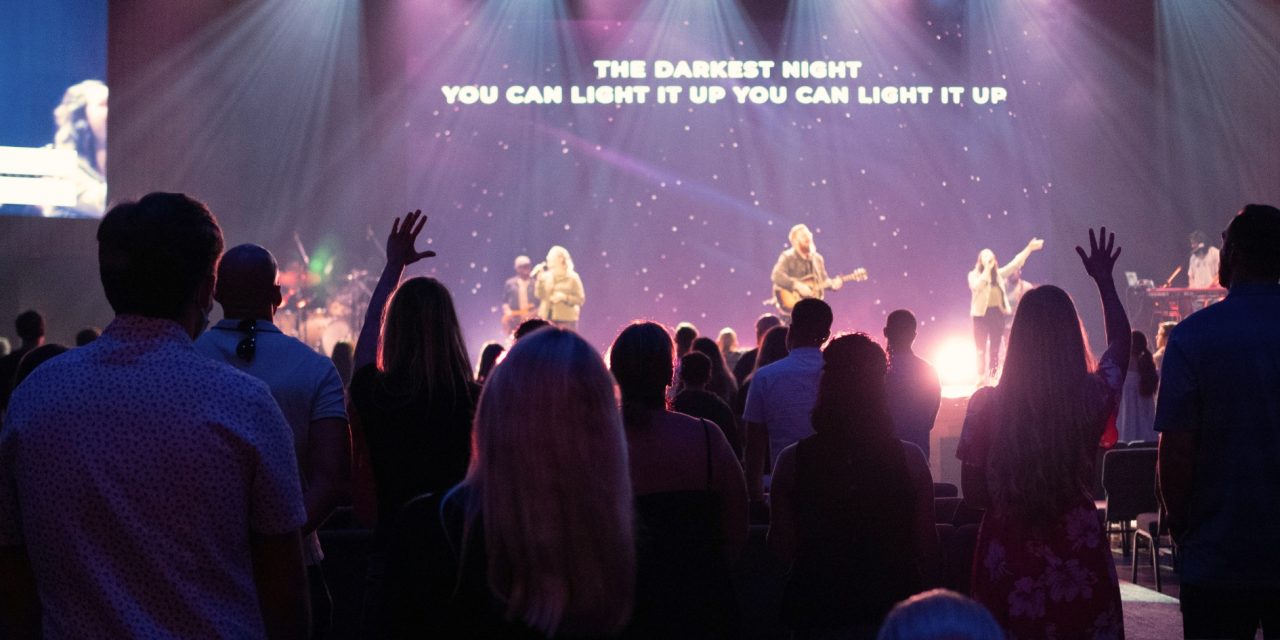
Some songs don’t need a cue, a key change, or even a lyric slide. Someone starts the first line, and the whole room just joins in—on pitch, on time, and with a kind of conviction that feels older than the moment itself. That’s not nostalgia doing the heavy lifting. That’s what happens when a song has quietly outlived trends, styles, and even generations.
This first part looks at four worship songs that have done exactly that. Not just surviving—but staying useful in real services, week after week. Different origins, different eras, same result: when they come up in a set, people don’t hesitate—they respond.
1. “How Great Thou Art” — Awe That Still Lands
Written by Carl Boberg in 1885 after a stormy experience, “How Great Thou Art” has traveled far beyond its Swedish roots (O Store Gud). Through Stuart K. Hine’s 1949 translation and later popularization by George Beverly Shea during the Billy Graham Crusades, it became a global staple.
What keeps it relevant is not just history—it’s structure. The verses build steadily, but the chorus opens up into something congregational. It gives people space to mean what they’re singing.
Churches still lean on it for moments that need weight—altar calls, communion, or simply when the room needs to refocus. Whether it’s a choir-backed arrangement or a stripped acoustic version, it holds.
2. “Amazing Grace” — Simplicity That Carries Weight
Written by John Newton in 1779, “Amazing Grace” doesn’t try to impress—it just connects. Its backstory alone carries weight, but what really sustains it is how accessible it is.
Eight notes. That’s it.
That simplicity is exactly why it works in almost any setting. You don’t need a strong band, a perfect key, or even confident singers. People find their way into it. And once they’re in, the message does the rest.
It shows up everywhere—from traditional hymnals to spontaneous moments in services—because it removes friction. No overthinking, no buildup. Just truth, sung plainly.
3. “It Is Well with My Soul” — Peace That Doesn’t Feel Forced
Few songs carry a backstory as heavy as this one. Horatio Spafford wrote “It Is Well with My Soul” in 1873 after losing his daughters in a tragic shipwreck. That context changes how you hear every line.
It’s not a hopeful song pretending everything is fine. It’s a steady declaration despite everything not being fine.
Musically, the progression mirrors that journey—starting low, almost restrained, then opening up into something more resolved. That’s why it still fits in modern services. It doesn’t rush emotion; it walks through it.
Worship leaders often place it in quieter moments, where people aren’t looking for hype—they’re looking for something honest.
4. “Holy, Holy, Holy” — Doctrine You Can Actually Sing
Written by Reginald Heber and later set to music by John Bacchus Dykes, “Holy, Holy, Holy” has lasted because it does something many songs struggle with: it carries deep theology without losing singability.
It draws heavily from scripture—especially Isaiah 6 and Revelation 4—yet it never feels like a lecture. The melody is steady, the phrasing is clear, and the repetition helps it settle in quickly.
That’s why it works across denominations. Whether it’s a traditional liturgical setting or a blended service, it translates. People don’t need to analyze it—they just step into it.
Conclusion
What stands out across these four songs isn’t just longevity—it’s function. Each one does something specific in a service. One builds awe, another invites reflection, another carries people through grief, and another grounds everything in truth. That’s why they haven’t faded—they’re still needed.
And that’s the real test of a worship song. Not how big it was when it was released, but whether it still holds a room years later without needing to be explained or updated.
Which of these songs have you actually heard people sing the loudest, no prompting, no hesitation, just pure conviction?
Stay rooted in the songs that still carry weight in real worship moments with DLK Praise and Worship.


