Easter planning sounds exciting—until you’re halfway through and nothing quite connects. You have the songs, the sermon, the visuals… but the flow feels off. That’s usually not a creativity problem. It’s a structural problem.
Scripture already gives a clear framework. When you follow it, your entire Easter experience begins to feel intentional instead of assembled.
What Shapes a Strong Easter Narrative
A cohesive Easter arc is built on five core themes drawn from 42 resurrection passages. These are not random ideas—they form a progression.
First is the suffering servant in Isaiah 53, which grounds the story in prophecy. Then comes substitutionary atonement in Romans 5:8, revealing the purpose behind the sacrifice. Victory declaration follows in 1 Corinthians 15:54–57, shifting the tone from loss to triumph.
Hope restoration in 1 Peter 1:3 reminds believers what the resurrection secures. Finally, commission sending in Matthew 28:19–20 moves everything outward into mission.
This progression shapes how your service should unfold. You begin with the Lamb of God in John 1:29, presenting Jesus as the perfect sacrifice. Then you move into the cup of wrath in Matthew 26:39, where the weight of the moment becomes clear.
At the center is “It is finished” (John 19:30). The word tetelestai means “paid in full,” marking the exact point where everything changes.
From there, the tone lifts with “He is risen” (Matthew 28:6). The empty tomb is not just a moment—it’s the turning point. Then the Great Commission (Matthew 28:18–20) ensures the story doesn’t end in celebration, but in action.
When these elements shape your sermon, music, and readings, your Easter service stops feeling scattered and starts telling a clear story.
Structuring Suffering, Death, and Victory
The most effective Easter services follow a three-part movement: suffering, death, and victory. Each part carries weight, and skipping one weakens the entire flow.
Suffering begins with Isaiah 53 and its 35 fulfilled prophetic details. This is where the emotional tone is set. The seven sayings from the cross in Luke 23 help bring this into focus.
Using scripture readings and reflective worship, especially acoustic Easter hymns, creates space for people to engage personally. This is not a rushed moment—it’s where understanding deepens.
Death follows with powerful imagery. The three hours of darkness and the tearing of the temple veil, measured at 60 by 30 feet, visually communicate the magnitude of what took place. Communion fits naturally here, supported by dim lighting and minimal instrumentation.
Again, tetelestai stands at the center. It is not just a statement—it is the declaration that the debt is fully settled.
Victory then shifts everything. Scripture records over 500 witnesses in 1 Corinthians 15:6 and multiple accounts of the empty tomb across the Gospels. These are not symbolic ideas—they are grounded events.
Historical notes from Josephus can also reinforce this for those who appreciate context beyond scripture.
At this stage, the atmosphere should change. Full-band worship, brighter visuals, and resurrection songs create a sense of celebration that feels earned. Ending with altar calls ensures the moment leads to response, not just applause.
Weekly Service Structures
A strong Easter experience is built over time, not just on one Sunday. Each service during Holy Week plays a role in the larger story.
A consistent structure helps maintain flow: Worship (25 minutes), Sermon (30 minutes), and Response (10 minutes). This can be adjusted for specific elements like processions or communion.
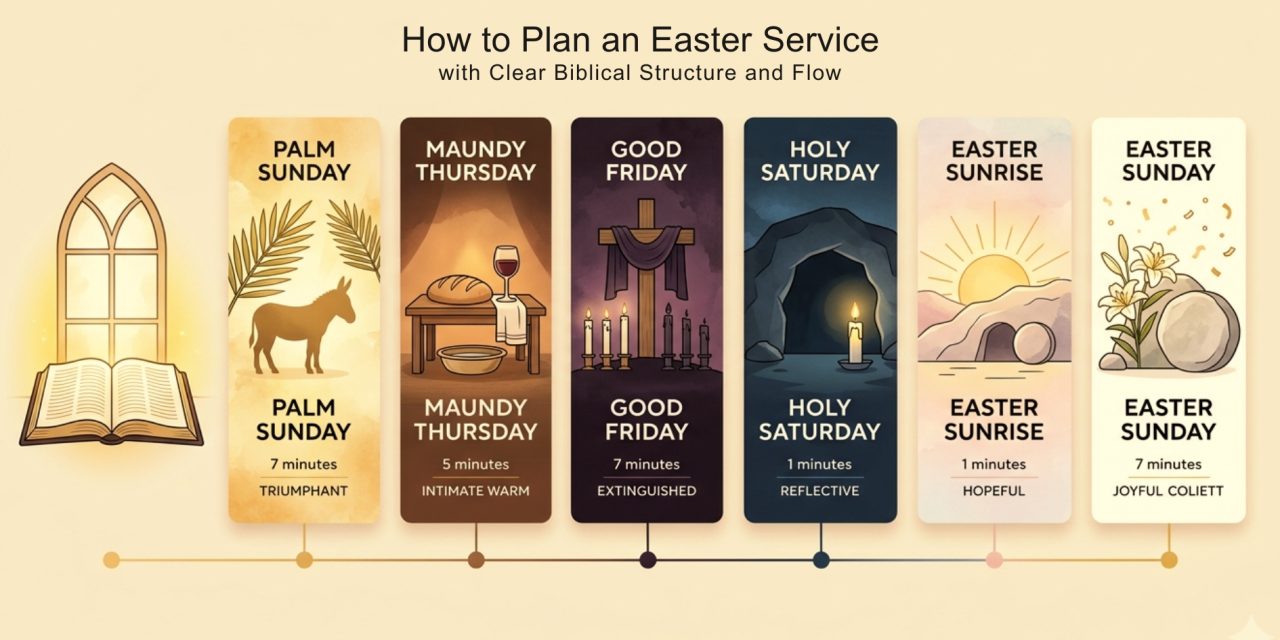
Here’s how the week typically unfolds:
| Service | Duration | Key Elements | Music Count | Visuals | Emotional Tone |
| Palm Sunday | 65min | Procession, sermon, palm waving | 5 songs | Palm branches, donkey imagery | Triumphant |
| Maundy Thursday | 90min | Last Supper recreation, foot washing, communion | 4 hymns | Table setup, bread and wine | Intimate |
| Good Friday | 75min | Tenebrae, extinguishing candles, scripture reading | 3 hymns | Cross veil, dimming lights | Somber |
| Holy Saturday | 60min | Vigil prayer, responsive reading, anticipation build | 2 songs | Dark tomb display, single candle | Reflective |
| Easter Sunrise | 50min | Outdoor call to worship, short message, baptism tease | 3 resurrection songs | Sunrise lighting, empty tomb | Hopeful |
| Easter Sunday | 110min | Victory celebration, baptism, altar call | 6 songs | Lilies, stone rolled away, confetti | Joyful |
Each service carries a distinct tone, but together they form a complete journey. When aligned well, the transition from reflection to celebration feels natural and powerful.
Conclusion
A meaningful Easter service is not built on isolated moments. Rather, it is shaped by intentional progression. When suffering, death, and victory are clearly structured, the message becomes easier to follow and harder to forget.
This kind of planning does more than improve flow. It helps people experience the story in a way that stays with them long after the service ends.
When you look at your current Easter plan, does it feel like a clear journey or just a series of good moments?
Be real in the comments, and keep building powerful, connected worship experiences with DLK Praise and Worship.