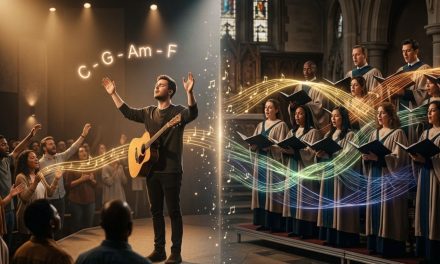
When everything is stripped back—no big drops, no layered production, no distractions—what remains is the true test of a worship song. Acoustic worship has a way of revealing that. It does not rely on volume or effects; it leans fully on message, presence, and sincerity.
While technology has shaped modern worship music in powerful ways, acoustic worship continues to draw people in for a different reason. This piece explores how, even in a production-heavy era, the heart of worship is often most clearly expressed through simplicity, vulnerability, and scripture-centered songwriting.
Technology’s Role—But Not the Center
Modern tools have undeniably shaped how worship music sounds today. Plugins like Waves compressors and Soundtoys effects have helped transform songs such as It Is Well by Bethel Music into polished, widely streamed recordings.
Over time, advancements like Pro Tools editing, immersive audio formats, and AI mastering have made high-quality production more accessible to churches and artists alike. These tools help refine sound, balance vocals, and prepare songs for larger audiences.
However, acoustic worship shifts the focus away from these enhancements. It reminds worship leaders that while technology can support a song, it cannot replace its core. Without strong lyrics and genuine expression, even the best production falls flat.
The balance, then, is not rejecting technology, but ensuring it never overshadows the message. Acoustic worship keeps that priority clear.
Lyrics and Vulnerability at the Center
Acoustic worship naturally brings lyrics forward. With fewer layers, every word becomes more noticeable, and every line carries more weight. Songs often reveal deeper scriptural connections when presented in a stripped-down format.
For example, acoustic versions of songs like Graves Into Gardens by Elevation Worship tend to highlight more direct biblical references and personal expressions than their full production counterparts. This creates a stronger sense of connection for listeners.
A helpful pattern emerges when comparing acoustic and full arrangements:
| Song | Acoustic Version | Full Version | Scripture Depth |
| Give Me Faith | Page CXVI acoustic | Passion original | More direct references |
| Reckless Love | Acoustic covers | Studio version | Stronger lyrical focus |
| Build My Life | Pat Barrett acoustic | Full band version | Clearer themes |
| It Is Well | Bethel acoustic | Studio production | Increased scriptural clarity |
This shift is not just technical; it is spiritual. Acoustic settings create space for honesty, whether in moments of surrender, gratitude, or lament.
Best practices for this approach include:
- Write lyrics first, focusing on truth and testimony
- Keep arrangements simple to support, not distract
- Use scripture as the foundation for themes
- Allow space for silence and reflection within songs
This approach strengthens both personal worship and congregational singing. It invites people to engage with meaning, not just sound.
Conclusion
Acoustic worship serves as a reminder of what matters most. In a time where production continues to advance, it brings the focus back to lyrics, presence, and authenticity.
By stripping away excess, it creates space for deeper connection, both individually and collectively. Whether in a small room or a large gathering, the simplicity of acoustic worship continues to highlight the heart behind every song.
When the music drops out and it’s just voices or a single instrument… do you lean in more, or do you miss the fullness of the band?Share your experience in the comments and keep shaping worship that truly connects with DLK Praise and Worship.